Web application development.
We build the web applications a business runs on: the customer portal, the internal tool, the dashboard your team lives in. The kind people actually like using, because it is quick and it just works, and the kind that stays that way as you grow. The same work has served millions of users and absorbed real traffic spikes in public without going down.
Part of our Cincinnati software studio// 01 · WHAT WE BUILD
THE WEB APPS YOUR
BUSINESS RUNS ON.
A web app is usually the tool your team opens every morning and the product your customers use to get something done. Those are the ones we build.
Customer-facing apps and portals.
The place your customers log in, do business, and come back to.
Internal tools and dashboards.
The software your team runs on, built around how they actually work instead of a spreadsheet that has outgrown the job.
Rebuilds and rescues.
Taking a slow, fragile, or half-finished app and making it fast and solid again.
The engine underneath.
Quick page loads, background jobs for the heavy work, and an architecture that holds up as your data and traffic grow.
// 02 · INTEGRATIONS
YOUR APP WORKS WITH THE TOOLS YOU ALREADY USE.
Almost every web app has to connect to other software to do its job. It takes payments through Stripe, posts into your team’s Slack, pulls from the CRM your salespeople already live in, hands off to a bank’s own systems, or calls an outside AI service to do the one thing it does best. Those connections are where a lot of apps quietly fail: a payment that never records, an order that never syncs, a login that works right up until the other side changes something.
We have wired apps into payment processors, pushed content to half a dozen publishing platforms from a single flow, connected third-party banking providers, and built against custom AI endpoints made for one project. When your software plugs cleanly into the tools you already run on, your people stop re-keying the same data in three places, and the whole thing starts to feel like one system instead of a stack of them.
// 03 · PERFORMANCE
SOFTWARE NOBODY HAS TO WAIT ON.
Slow software costs a business time all day: the report that takes a minute, the page that hangs, the tool your team dreads opening. It adds up, and it wears people down.
We build fast by default, and when we take on something that is already slow, we make it quick. One warehouse system came to us timing out under its own weight; we rebuilt it to respond instantly. Fast is a decision we make in the architecture, not a finishing touch, which is what keeps an app pleasant to use long after launch.
// 04 · THE UNGLAMOROUS HALF
IT STILL WORKS TWO YEARS FROM NOW, NOT JUST ON LAUNCH DAY.
A web app that works in a demo and one that still works in two years are separated by a long list of unglamorous things most shops quietly skip.
Automated deployments
so a release is routine instead of a nerve-wracking event.
Security passes
with every finding reviewed and closed, not just filed.
QA across real devices
on real phones, tablets, and browsers, including the old ones your customers have not upgraded.
Uptime monitoring and error alerts
so you hear about a problem before your users do.
Secrets stored properly
kept out of the code and locked down, where they belong.
Cookie consent that works
actually turning things off when someone says no.
You will never notice most of it, and that is the point. It is the half of the job that keeps the other half standing, and it starts earlier than people expect.
Most of what a web app will cost you is decided in its first two weeks, in the platform and the architecture, so we set that foundation properly before anything gets built on top of it. The feature you dream up in month six should never mean starting over, and when the groundwork is right, it does not.
// 05 · THE REAL WORLD
IT WORKS EVERYWHERE YOUR CUSTOMERS ACTUALLY USE IT.
Your customers reach a web app from everywhere: inside Instagram’s browser, inside LinkedIn’s app, on a five-year-old phone, on slow hotel wifi, with a keyboard covering half the screen. Every one of those is a spot where an app can look perfect on your machine and still break on theirs.
We once chased down a layout that broke only when someone opened the link from inside Instagram, and only on a phone, the kind of bug most shops would never find and would wave off if they did. Knowing where real conditions break software is what experience buys you, and it means fewer surprises once your customers are actually using it.
// 06 · PROOF
WEB APPS THAT
HANDLE REAL USERS.
The real test of a web app is whether it holds up once real people are using it, and we give a tool for a team of ten the same care as a platform for millions. Three that did.

National Grid
An enterprise website and content platform serving millions of utility customers.
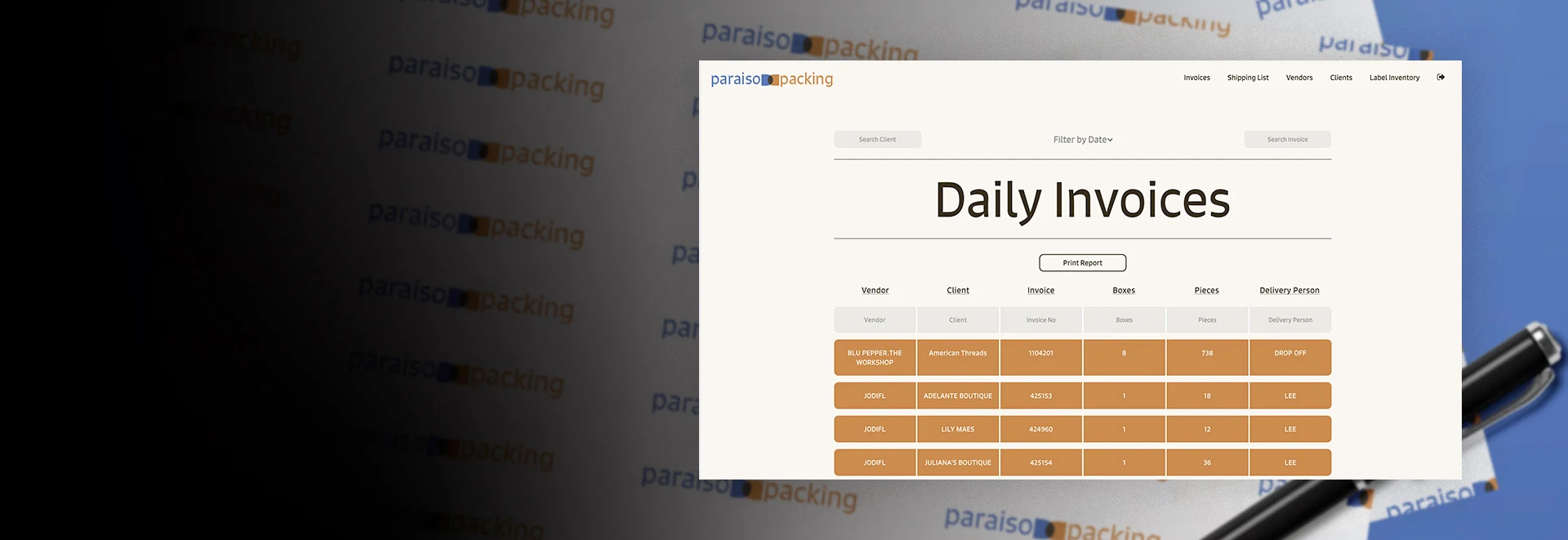
Paraiso Packing
A warehouse system we rebuilt from constant timeouts to instant.

Ruska Roma
A campaign platform that absorbed studio-scale traffic spikes in public for a month without going down.
And the same care goes into everything we ship, from a tool for a team of ten to a platform for millions.
See all work// 07 · FAQ
COMMON QUESTIONS.
How much will it cost?
It depends on scope, so there is no single price, but you will never be surprised by it. We scope the work first and give you a fixed number before you commit. If the full vision is more than the budget right now, we start with a focused first version that fits it and grows from there.
How long will it take?
A focused first version usually ships in weeks to a few months, depending on scope. You see working software every week along the way, so you are never left waiting to find out whether it is on track, and we give you a real timeline after scoping.
Can you fix or take over an app we already have?
Yes. A lot of our work is taking a slow, fragile, or stalled web app and making it solid, or stepping into a codebase someone else started and moving it forward.
Will it scale as we grow?
Yes. We build the architecture to grow with your traffic and your data from the start, the same way the work above has handled millions of users and real spikes without going down.
Who owns the code?
You do. The code, the data, all of it is yours from day one, and it is built so your own team or another shop can run it whenever you want.
// START HERE
TELL US WHAT
YOU'RE BUILDING.
Twenty minutes with a senior engineer, and you'll leave with how we'd build it, roughly what it takes, and what we'd worry about first. We read every message ourselves and reply within one business day.
A rough idea is enough to start.
That's in front of us now.
You'll hear back within one business day, from an engineer rather than a form letter. Nothing else needed on your end.
Or just email us at hello@queencity.io